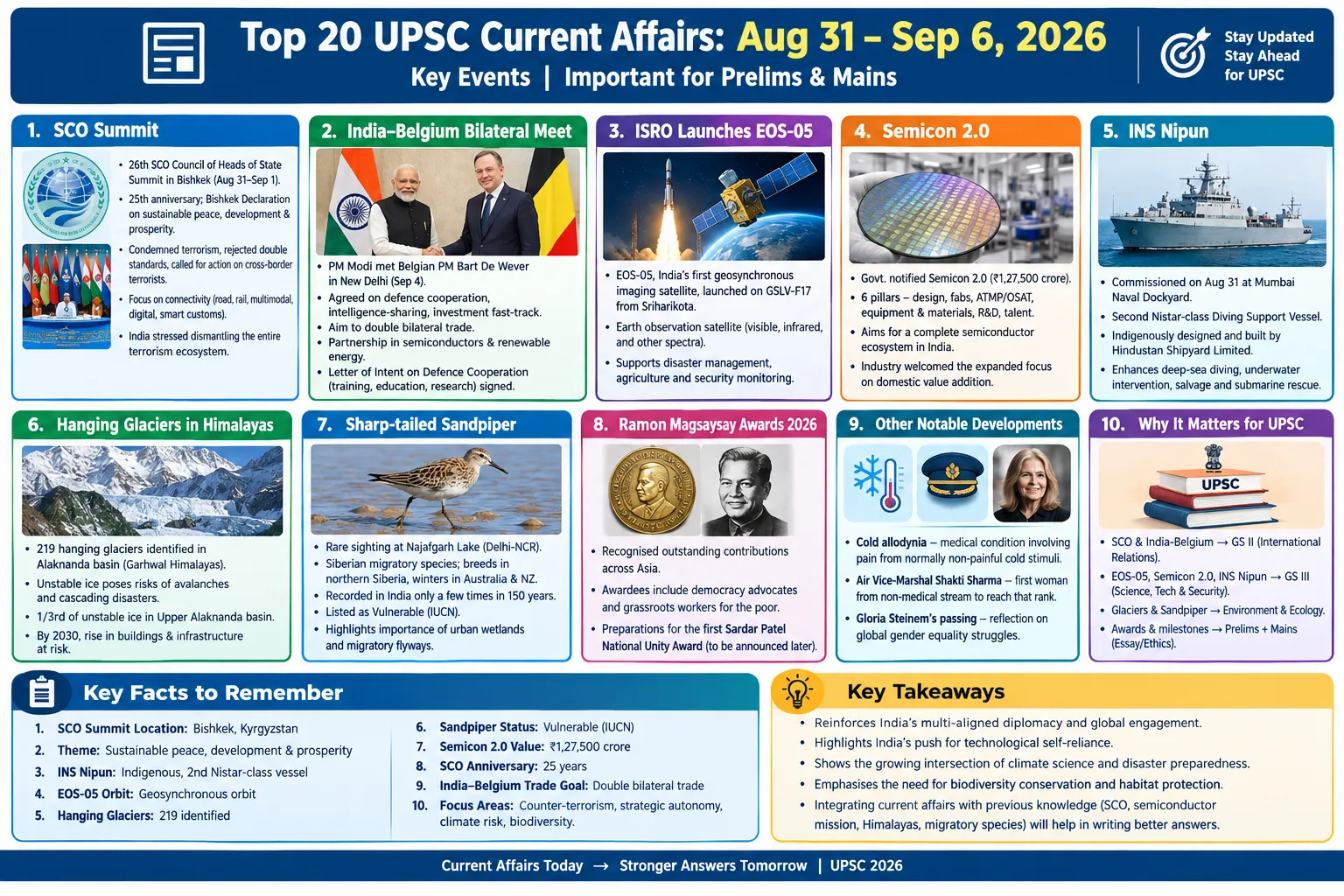
The week from August 31 to September 6, 2026, delivered a rich set of developments spanning international relations, science and technology, environment, defence, and awards. For UPSC aspirants, these events offer high-relevance material for both Prelims fact-based questions and Mains analytical answers. Below is a structured overview of the most significant current affairs pointers from the period.
International Relations and Diplomacy
The 26th Shanghai Cooperation Organisation Council of Heads of State Summit was held in Bishkek, Kyrgyzstan, from August 31 to September 1. Marking the 25th anniversary of the SCO, the summit adopted the Bishkek Declaration under the theme of sustainable peace, development and prosperity. The declaration strongly condemned terrorism in all its forms, rejected double standards, and called for action against the cross-border movement of terrorists. It also emphasised connectivity through modernised road and rail routes, multimodal corridors, digital technologies and smart customs. India highlighted the need to dismantle the entire ecosystem of terrorism, including financing, recruitment and safe havens.
On the bilateral front, Prime Minister Narendra Modi met Belgian Prime Minister Bart De Wever in New Delhi on September 4. The two sides agreed to strengthen defence cooperation and intelligence-sharing, create an investment fast-track mechanism, work towards doubling bilateral trade, enhance partnership in semiconductors, and sign a pact on renewable energy. A Letter of Intent on Defence Cooperation covering training, education and research was also finalised. These steps reflect India’s expanding engagement with European partners beyond traditional trade.
Science, Technology and Space
ISRO successfully launched EOS-05, India’s first geosynchronous imaging satellite, aboard GSLV-F17 from Sriharikota. The Earth Observation satellite is designed for advanced imaging across visible, infrared and other spectra from a geosynchronous orbit, strengthening capabilities in disaster management, agriculture, and security-related monitoring.
The government formally notified Semicon 2.0, a Rs 1,27,500 crore programme building on the earlier Semicon 1.0 initiative. Structured around six pillars—design, fabs, ATMP/OSAT, equipment and materials, R&D, and talent—the scheme aims to move India from basic manufacturing capacity towards a full semiconductor ecosystem. Industry bodies welcomed the expanded focus on domestic value addition across the supply chain.
Defence and Security
The Indian Navy commissioned INS Nipun, the second Nistar-class Diving Support Vessel, at the Naval Dockyard in Mumbai on August 31. Indigenously designed and built by Hindustan Shipyard Limited, the vessel enhances deep-sea diving, underwater intervention, salvage and submarine rescue capabilities. Together with INS Nistar, it significantly strengthens India’s ability to respond to undersea emergencies.
Environment and Climate
A scientific study published earlier in the year and widely discussed this week identified 219 hanging glaciers in the Alaknanda basin of the Garhwal Himalayas. These unstable ice masses perched on steep slopes pose risks of sudden detachment, avalanches and cascading disasters. Nearly one-third of the unstable ice is concentrated in the Upper Alaknanda basin. Projections indicate a substantial rise in buildings and infrastructure at risk by 2030, underscoring the growing vulnerability of Himalayan settlements and hydropower projects to climate-driven glacial hazards.
Biodiversity and Conservation
A rare sighting of the Sharp-tailed Sandpiper was recorded at Najafgarh Lake in the Delhi-NCR region. This Siberian migratory species, which breeds in northern Siberia and winters mainly in Australia and New Zealand, has been documented in India only a handful of times over nearly 150 years. The bird is listed as Vulnerable on the IUCN Red List, with its population having declined significantly. The sighting highlights the importance of urban wetlands as stopover habitats even for vagrant species and raises questions about habitat quality along migratory flyways.
Awards and Recognition
The 2026 Ramon Magsaysay Awards were announced, recognising outstanding contributions across Asia. Among the awardees were individuals noted for democracy advocacy and grassroots work with the poor. Separately, preparations advanced for the first Sardar Patel National Unity Award, instituted by the Ministry of Home Affairs and scheduled for announcement later in the year.
Other Notable Developments
Discussions around cold allodynia—a medical condition involving pain from normally non-painful cold stimuli—appeared in science coverage relevant to health and physiology topics. Air Vice-Marshal Shakti Sharma’s elevation marked a milestone as the first woman officer from a non-medical stream to reach that rank in the Indian armed forces. The passing of Gloria Steinem, a leading figure of the second-wave feminist movement, prompted reflection on global gender equality struggles.
Relevance for UPSC Preparation
These developments map directly onto the UPSC syllabus. The Bishkek Declaration and India-Belgium outcomes fall under GS Paper II (International Relations). EOS-05, Semicon 2.0 and INS Nipun are relevant for GS Paper III (Science & Technology and Security). Hanging glaciers and the Sharp-tailed Sandpiper connect to Environment and Ecology. Awards and institutional milestones support both Prelims static-current linkages and Mains essay or ethics dimensions.
Aspirants should note precise details such as the location and theme of the SCO summit, the indigenous nature of INS Nipun, the geosynchronous orbit of EOS-05, the number of hanging glaciers identified, and the conservation status of the sandpiper. Linking these facts to broader themes—counter-terrorism norms, strategic autonomy, climate risk in the Himalayas, and biodiversity conservation—will strengthen analytical answers.
The week underscored India’s multi-aligned diplomacy, technological self-reliance efforts, and the growing intersection of climate science with disaster preparedness. For examination purposes, integrating these pointers with previous knowledge on SCO, semiconductor missions, Himalayan cryosphere, and migratory species will yield the best results. Consistent revision of such weekly compilations remains one of the most effective strategies for staying current without information overload.
Read more – Thepowerfuldua.com , yandex-games.org