The completion of India’s dedicated freight rail network marks a significant milestone in the country’s logistics infrastructure. With the inauguration of the final three sections of the Western Dedicated Freight Corridor, the full 2,843-kilometre system is now operational. These sections, spanning Gujarat and Maharashtra, complete the 1,506-kilometre Western corridor that links the Jawaharlal Nehru Port Trust in Navi Mumbai to Dadri near Delhi. Together with the already operational Eastern corridor, the network is designed to move goods faster, at lower cost, and with greater reliability while freeing capacity on conventional passenger lines.
Completion of the Western Corridor
Prime Minister Narendra Modi inaugurated the last three stretches of the Western Dedicated Freight Corridor in Vadodara. The sections—New Sanand North to New Makarpura, New Umbergaon to New Saphale, and New Saphale to New JNPT—cover 326 route kilometres and were developed at a cost exceeding Rs 20,700 crore. Their commissioning closes the final gaps on the Western corridor and provides uninterrupted dedicated track from one of India’s busiest container ports directly into the northern industrial hinterland.
The Western corridor runs through Maharashtra, Gujarat, Rajasthan, Haryana and Uttar Pradesh. It primarily handles ISO containers originating from JNPT and other western ports such as Mundra, Kandla and Pipavav, destined for inland container depots in the National Capital Region, Punjab and Rajasthan. The route is also expected to carry bulk commodities including fertilisers, foodgrains, salt, coal, iron, steel and cement.
Scale of the Full Network
The completed network consists of two corridors. The Western Dedicated Freight Corridor measures 1,506 kilometres from JNPT to Dadri. The Eastern Dedicated Freight Corridor, fully commissioned earlier, covers 1,337 kilometres from Ludhiana in Punjab to Sonnagar in Bihar. Combined, they form a 2,843-kilometre dedicated freight system—the backbone of India’s high-capacity rail freight operations.
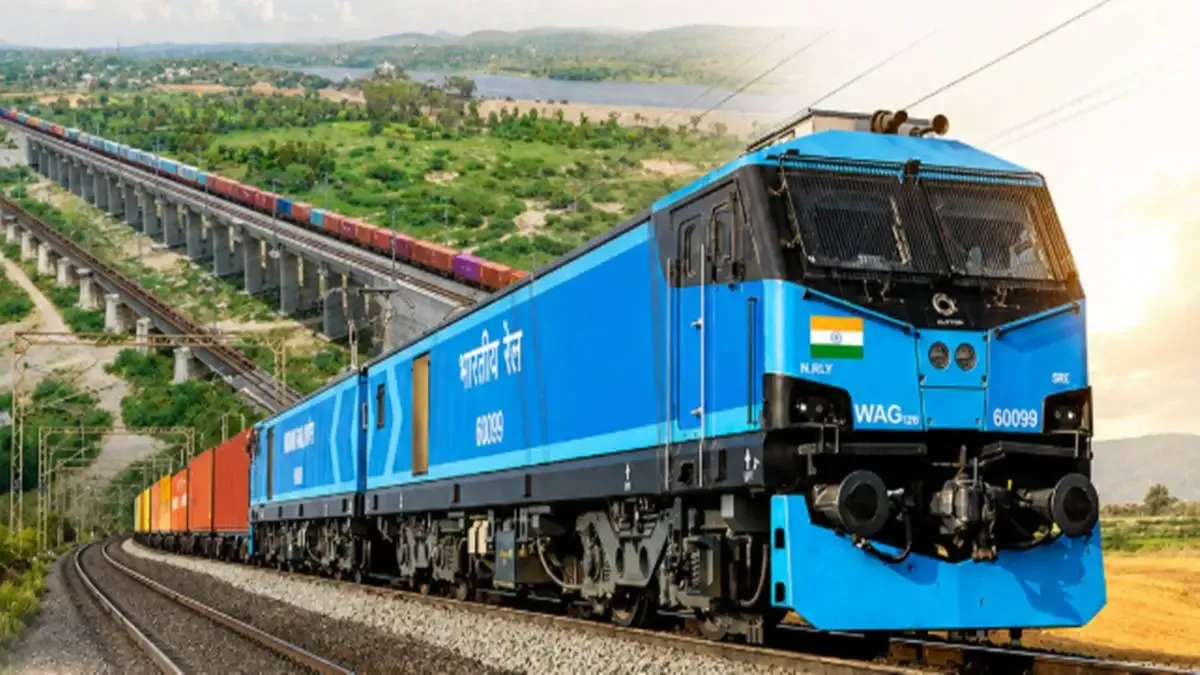
Both corridors are electrified and built to higher standards than the conventional mixed-traffic network. They support heavier axle loads and, on the Western corridor in particular, double-stack container trains. This configuration allows significantly more cargo to be moved per train while reducing energy consumption and emissions compared with single-stack or road transport.
Operational Performance and Efficiency Gains
More than 400 freight trains currently operate daily on the dedicated corridors, with recent averages reaching around 430 to 443 trains. The separation from passenger services has delivered measurable improvements. Average speeds on the corridors exceed 50 kilometres per hour—roughly double the speed of freight trains on the conventional network. Transit time between Dadri and JNPT has fallen from approximately 66 hours to about 58 hours following the opening of the final stretch.
These gains translate into lower logistics costs, faster turnaround of rolling stock, and greater reliability for shippers. Goods that once took around 30 hours by road over certain distances can now complete the journey in 10 to 12 hours by rail on the dedicated network. The corridors also ease congestion on busy passenger routes around Mumbai and other urban centres by shifting freight traffic onto exclusive tracks.
Strategic Benefits for Ports and Industry
Direct connectivity to JNPT is one of the most important outcomes. Container trains can now run from the port onto the dedicated network without relying on congested conventional lines for the last stretch. This improves the competitiveness of Indian ports and supports export-import trade. Industrial hubs in Gujarat, Rajasthan, Haryana, Delhi-NCR and western Uttar Pradesh gain a more efficient link to western seaports, strengthening supply chains for manufacturing and bulk commodities.
The infrastructure aligns with broader national goals of reducing overall logistics costs and improving multimodal connectivity. By enabling higher capacity and more predictable schedules, the corridors make rail a more attractive option relative to road for long-haul freight. This shift has environmental benefits through lower fuel use and reduced road congestion, while also supporting the Railways’ ability to expand passenger services on freed-up conventional tracks.
Last-Mile Connectivity and Future Outlook
In addition to the main corridors, the network incorporates last-mile links at key locations, allowing seamless transfer to inland container depots and industrial sidings. The Dedicated Freight Corridor Corporation of India Limited has overseen construction and operations, with progressive commissioning of sections over several years culminating in full operationalisation.
The completed system already demonstrates robust performance in container, coal and bulk cargo movement. As utilisation increases with the final Western sections online, further growth in freight volumes is expected. Higher speeds, double-stack capability and dedicated capacity position the corridors as a long-term foundation for India’s logistics modernisation.
The 2,843-kilometre network represents a fundamental upgrade in how goods move across the country. By cutting transit times, lowering costs and providing reliable last-mile connections, the Eastern and Western Dedicated Freight Corridors strengthen the competitiveness of Indian industry and trade. Their full commissioning marks the transition from a long-gestation infrastructure project to an operational asset that will shape freight movement for decades to come.
Read more – amazonsalesday.org