Google is set to unveil its next generation of flagship smartphones at the Made by Google event on August 12. The Pixel 11 series is widely expected to include four models—the Pixel 11, Pixel 11 Pro, Pixel 11 Pro XL, and Pixel 11 Pro Fold—continuing the expanded lineup approach of recent years. While official details remain under wraps until the event, a steady stream of leaks, retailer listings and design teasers has painted a clear picture of what to expect in terms of pricing, design, hardware and software.
Confirmed Launch Timeline
Google has officially scheduled the Made by Google hardware event for August 12. The keynote is timed for 3pm PT (6pm ET), later than some previous presentations. Pre-orders are anticipated to open the same day, with general availability expected later in August for the slab models. The foldable is often reported to follow a slightly delayed shipping window, consistent with previous Pixel Fold releases.
Expected Lineup and Pricing
Reports consistently point to four devices. US pricing leaks suggest a modest increase over the previous generation in several configurations, with 256GB becoming the new base storage tier in many markets.
-
Pixel 11: Expected to start at $899 for the 256GB model.
-
Pixel 11 Pro: Expected to start at $1,099.
-
Pixel 11 Pro XL: Expected to start at $1,299.
-
Pixel 11 Pro Fold: Expected to start at $1,899.
Higher storage options (512GB and 1TB on select models) carry corresponding premiums. European pricing leaks show similar upward adjustments in some markets. These figures remain unconfirmed until Google’s official announcement.
Design and Colour Options
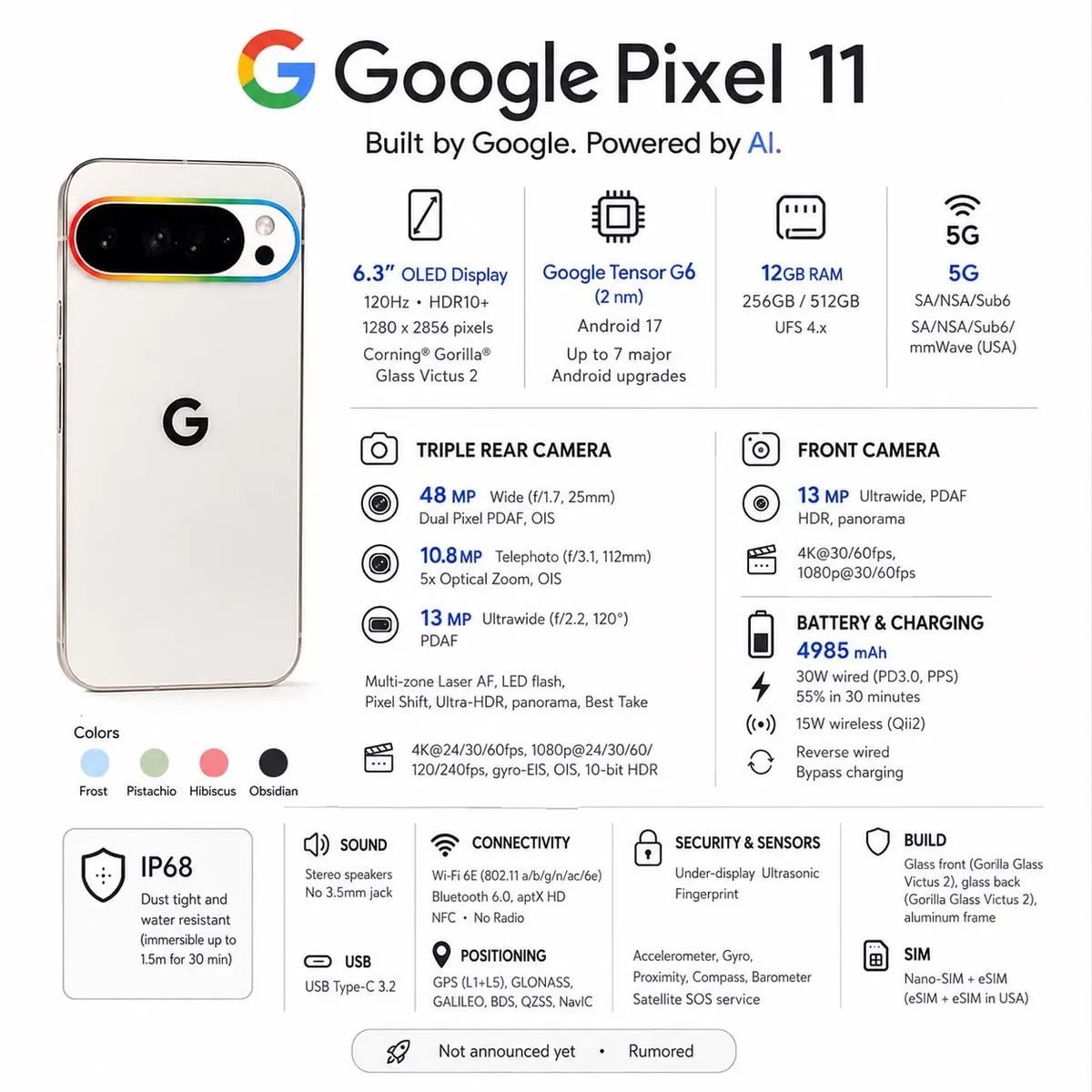
Google has already begun teasing elements of the design, including a gold-finish frame visible in promotional material. Leaked renders indicate the series retains the distinctive camera bar while refining edges and finishes. Colour options vary by model. The standard Pixel 11 is linked to names such as Frost, Hibiscus, Obsidian and Pistachio. Pro models are frequently associated with Dune, Light Fog, Midnight (or Midnight Haze) and Pine. The foldable is expected to share a more limited palette focused on darker and neutral tones.
A new visual feature generating interest is Pixel Glow, an RGB lighting system reportedly integrated into the camera bar area. It is expected to handle notifications and potentially interact with AI features, appearing more prominently on the Pro models.
Display Specifications
The base Pixel 11 and Pixel 11 Pro are both tipped to use 6.3-inch OLED panels, with the Pro version offering a higher-resolution LTPO display and greater peak brightness. The Pixel 11 Pro XL is expected to move to a larger 6.8-inch panel. All non-fold models are reported to support adaptive 120Hz refresh rates. The Pixel 11 Pro Fold is expected to retain a dual-display setup with a cover screen around 6.3–6.4 inches and an inner foldable display of approximately 8 inches, both OLED and supporting high refresh rates.
Processor, Memory and Software
The entire Pixel 11 series is expected to be powered by Google’s Tensor G6 chipset, paired with the Titan M3 security coprocessor. Multiple reports indicate the G6 moves to a more advanced process node (commonly cited as TSMC’s 2nm), which should deliver efficiency and performance gains over the previous generation. A MediaTek modem is also frequently mentioned in connection with improved connectivity.
RAM configurations are reported to start at 12GB on base storage variants of some models, with 16GB available on higher storage tiers. All four phones are expected to ship with Android 17 out of the box, continuing Google’s pattern of offering the purest and longest software support in the Android ecosystem.
Camera Systems
Camera hardware remains a central focus. The standard Pixel 11 is widely reported to feature a dual rear setup led by a high-resolution primary sensor and an ultra-wide, with computational zoom capabilities extending the reach. The Pixel 11 Pro and Pro XL are expected to carry a more advanced triple-camera array, including a high-resolution main sensor, an ultra-wide with macro support, and a periscope telephoto offering 5x optical zoom and extended digital zoom. Front-facing cameras are also tipped for upgrades on the Pro models. The foldable is expected to use a slightly different camera configuration optimised for its form factor, with dual selfie cameras covering both the cover and inner displays.
Battery and Charging
Battery capacities are reported in the range of roughly 4,800–5,100mAh depending on the model, with the Pro XL expected to offer the largest cell. Wired charging speeds are tipped to improve on the Pro models, while wireless charging (including Qi2 support in some reports) and reverse wireless charging are expected to continue.
What to Watch for on August 12
Beyond the core specifications, attention will focus on real-world performance of the Tensor G6, the practical usefulness of Pixel Glow, camera refinements in varied lighting, and any new AI features built into Android 17 and the Pixel experience. Pricing confirmation and regional availability details will also clarify how the lineup positions itself against competing flagships.
The Pixel 11 series arrives at a moment when Google continues to emphasise computational photography, clean software and tighter hardware-software integration. While many of the reported upgrades appear evolutionary rather than revolutionary, the combination of a new Tensor generation, refined design details and the expanded four-model approach gives the upcoming event clear significance for Pixel followers.
Until Google takes the stage on August 12, the details above remain based on consistent reporting and leaks. Official confirmation will arrive during the Made by Google keynote, after which pre-order and availability information will determine how quickly the new devices reach customers.
Read more – morecai.com