A day after becoming the first Indian to win the Grand Chess Tour title, R Praggnanandhaa reflected on a dramatic comeback and his approach to elite chess. The 21-year-old grandmaster overturned a six-point deficit against Fabiano Caruana in the St. Louis finals to claim the crown, the $200,000 prize and a berth on the 2027 tour. In the hours that followed, his comments returned repeatedly to a simple idea: he is still having fun with the game.
Overturning the Odds
Praggnanandhaa began the final day trailing 3-9 after the classical games. Few expected a turnaround against a player of Caruana’s consistency and experience. Yet the Indian delivered precisely when it mattered. He won both rapid games to seize the lead, then navigated a tense blitz segment. After a draw and a loss that levelled the scores at 12-12, he won the third blitz game and secured the required draw in the last encounter to finish 15-13.
Afterwards he was characteristically understated. “Honestly, I didn’t think I had many chances today. Six points is a lot,” he said. He noted that scoring two rapid wins against Caruana was unusual and decisive. The result capped a season in which his rapid and blitz form had clearly improved, giving him the tools to compete across the Grand Chess Tour’s demanding multi-format structure.
The Value of Enjoyment
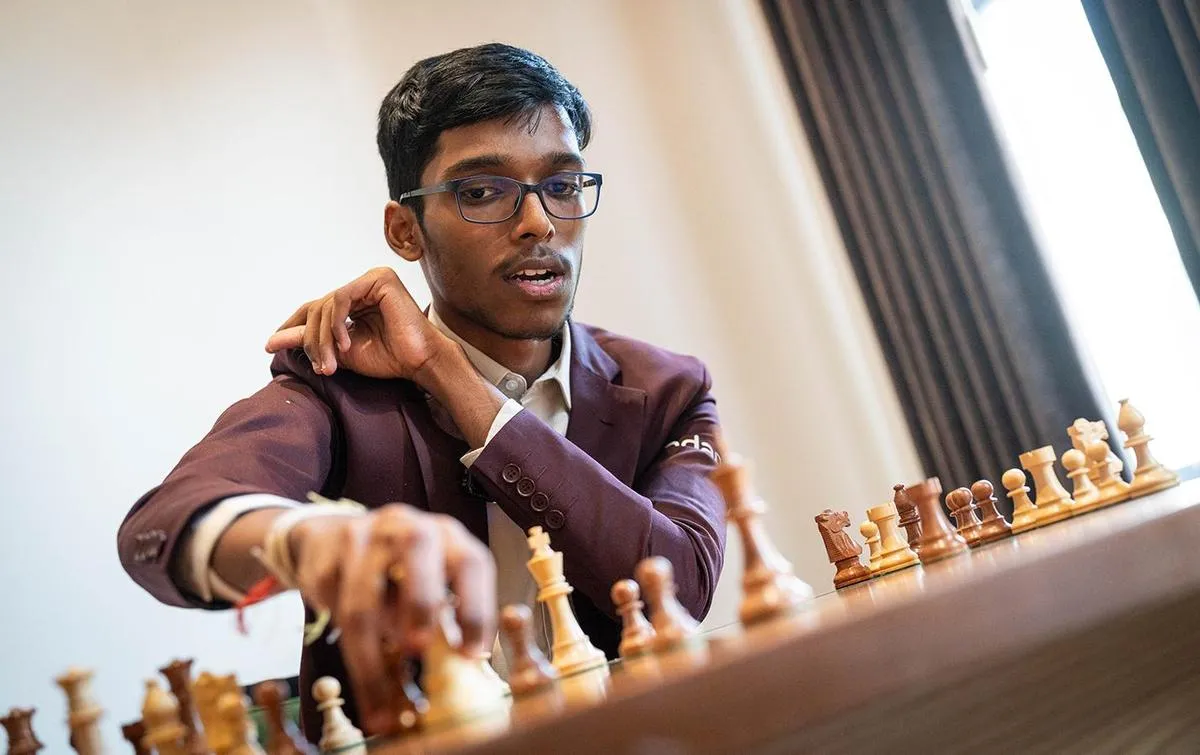
Across interviews in recent months, Praggnanandhaa has spoken about the importance of still finding pleasure in sitting at the board. He has described how relentless scheduling can lead to mental fatigue even when results are positive, and how the same routine tournament after tournament risks turning the game automatic. In that context, his insistence on enjoyment is not casual. It is a deliberate stance against burnout.
“Whenever I sit at the board, I just enjoy it,” he has said. Some events, he notes, carry a clear goal of winning; others allow a freer sense of competing against strong fields in interesting formats. The Grand Chess Tour, with its mix of classical, rapid and blitz, sits in the former category, yet the underlying attitude remains the same. Fun and seriousness coexist. The ability to stay engaged with the pure act of playing appears central to sustaining performance at the highest level.
Lessons from Setbacks
The Grand Chess Tour triumph arrived after a difficult Candidates Tournament earlier in the year, where Praggnanandhaa finished near the bottom of the field with only one win in 14 games. He has not hidden the disappointment. “It would have been nice to have it in the Candidates, but it’s still nice to win tournaments like this,” he remarked after the final. The comment captures a mature perspective: big goals remain, yet present successes are still worth celebrating.
Those around him point to character as much as calculation. Even when trailing significantly, he showed no inclination to accept second place. The determination to keep fighting made the final-day recovery possible and eased the work of his support team, who stayed available across time zones to discuss strategy between games.
Credit to the Team
Praggnanandhaa has been careful to acknowledge the people behind the results. He singled out trainers Ramesh and Vaibhav Suri, noting that Suri adjusted his own sleep schedule to remain online in the early hours in India. The young grandmaster’s willingness to share credit reflects an understanding that elite performance is rarely a solo effort. Consistent high-level chess requires preparation, recovery, and trusted voices who can help navigate critical moments.
A Broader Career Perspective
At 21, Praggnanandhaa already carries the expectations that come with being part of India’s new generation of world-class players. He has spoken about the need to prioritise and avoid the mental exhaustion that can follow an overloaded calendar. The desire to keep the game enjoyable sits alongside the ambition to win major titles. The World Championship remains the ultimate benchmark; the Grand Chess Tour, in his view, ranks immediately below it in tradition and stature.
His recent comments suggest a player consciously managing the balance between drive and sustainability. Enjoyment is not presented as the opposite of hard work. It is framed as a necessary ingredient if the work is to continue productively over many years.
Looking Forward
The St. Louis victory guarantees continued participation at the highest level of the Grand Chess Tour and adds a landmark achievement to a rapidly growing list. For Indian chess it represents another historic first. For Praggnanandhaa himself it appears to reinforce a working philosophy: prepare thoroughly, compete fully, and still find pleasure in the game itself.
In free-flowing conversations after major results, he tends to avoid grand declarations. He acknowledges the difficulty of the task just completed, notes areas of improvement, thanks those who supported him, and returns to the board as a place of genuine interest. A day after the Grand Chess Tour Final triumph, that grounded outlook remained intact. He is still, by his own account, just having fun with the game—and producing results that suggest the approach is working.
Read more – Instantdua.com